

Physics
Physical Sciences
Research
PhD
Research
PhD
Overview
Application Timeline
Tuition
- Year 1
| Student categories | Study | |
|---|---|---|
| Full-time | Part-time | |
| England | £4,850 | £2,379 |
| Northern Ireland | £4,850 | £2,379 |
| Scotland | £4,850 | £2,379 |
| Wales | £4,850 | £2,379 |
| Channel Islands | £4,850 | £2,379 |
| EU | £26,700 | N/A |
| International | £26,700 | N/A |
Requirements
Language requirements information is currently unavailable.
Modules
Modules is currently unavailable
Please check back later for updates.
About
Overview
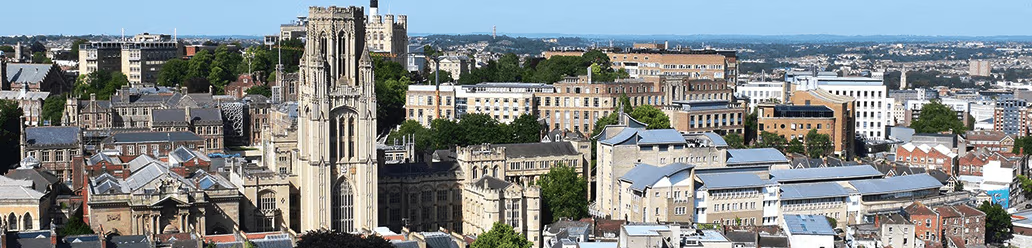
The School of Physics at Bristol University is recognized as one of the leading research environments in the UK, ranked 4th in the UK for Physics research according to THE analysis of REF 2021. The school has a rich history of significant contributions to physics, including the discovery of the pi meson, which earned a Nobel Prize in 1950.
Graduate School Community
As a research student, you will join the Physics Graduate School, which consists of around 250 students from diverse backgrounds and maintains a good gender balance. The school has strong ties with industry and the local start-up community, offering opportunities for...
Subject Area Information
Physics is a fundamental scientific discipline that explores the nature and properties of matter and energy. It encompasses a wide range of topics, from the smallest subatomic particles to the vastness of the universe. Courses in physics are designed to provide students with a deep understanding of the principles that govern the physical world, as well as the mathematical tools needed to describe and predict physical phenomena.
1. Classical Mechanics
2. Electromagnetism
3. Thermodynamics and Statistical Mechanics
4. Quantum Mechanics
5. Optics
6. Relativity
- Analytical Thinking
- Mathematical Proficiency
- Experimental Skills
- Computational Skills
Career
Physics is a versatile and rigorous discipline that equips students with a broad skill set applicable to a wide range of careers. Through a combination of theoretical knowledge and practical experience, students are prepared to tackle some of the most challenging and exciting problems in science and technology.
Research Scientist
Conducting experiments and developing theories in academic, government, or industrial research labs.
Engineer
Applying physical principles to design and improve technologies in fields such as aerospace, electronics, and materials science.
Data Analyst
Using statistical and computational methods to analyze large datasets in industries like finance, healthcare, and technology.
Educator
Teaching physics at the high school, college, or university level, and developing educational materials and curricula.
Medical Physicist
Applying physics to medical technologies and treatments, such as imaging and radiation therapy.
Similar courses
Contact


Enhance your academic journey with the help from our experts.
Contact
Enhance your academic journey with the help from our experts.