

Palaeobiology
Geography, Earth and Environmental Studies
Taught
MSc
Taught
MSc
Overview
Application Timeline
Tuition
- Year 1
| Student categories | Study | |
|---|---|---|
| Full-time | Part-time | |
| Channel Islands | £13,900 | £6,950 |
| England | £13,900 | £6,950 |
| Northern Ireland | £13,900 | £6,950 |
| Scotland | £13,900 | £6,950 |
| Wales | £13,900 | £6,950 |
| EU | £30,500 | N/A |
| International | £30,500 | N/A |
Requirements
Language requirements information is currently unavailable.
Modules
Modules is currently unavailable
Please check back later for updates.
About
Programme Focus
This interdisciplinary MSc programme is designed for students interested in:
- Early life
- Mass extinctions
- Macroevolution
- Climate change
- Fossil preservation
The programme bridges the biology-geology divide and equips students with skills in phylogenetics, biomechanics, and macroevolution, preparing them for independent research or careers in various fields.
Institutional Excellence
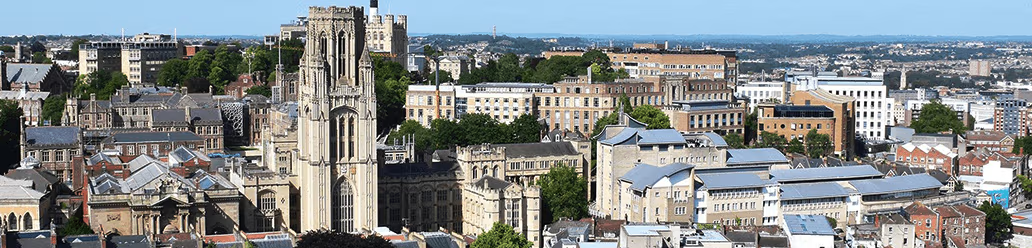
Bristol University is highly regarded, ranked:
- Second in the UK for 'Earth systems and environmental sciences' (THE analysis of REF 2021)
- First in the world for Palaeontology (Center for World University Rankings 2017)
Students will engage with...
Subject Area Information
Palaeontology is the scientific study of the history of life on Earth through the examination of plant and animal fossils, bridging biology and geology to provide insights into the evolution of organisms, their interactions, and the environments they inhabited.
1. Introduction to Palaeontology
2. Invertebrate Palaeontology
3. Vertebrate Palaeontology
4. Paleobotany
5. Micropalaeontology
6. Paleoecology and Taphonomy
7. Evolutionary Biology
8. Field Methods in Palaeontology
- Analytical Skills
- Research Skills
- Technical Skills
- Critical Thinking
- Communication Skills
Career
Graduates of palaeontology courses can pursue diverse careers in research, education, museum curation, environmental consulting, and more, contributing to our understanding of the natural world and its history.
Palaeontologist
Conducting research and fieldwork to discover and study fossils.
Museum Curator
Managing fossil collections, designing exhibits, and conducting educational programs.
Academic Researcher/Professor
Teaching and conducting research in universities and academic institutions.
Geologist
Applying paleontological knowledge in the exploration of natural resources such as oil and gas.
Environmental Consultant
Using paleontological data to assess environmental changes and impacts.
Science Communicator
Writing, presenting, and creating content to educate the public about paleontology.
Similar courses
Contact


Enhance your academic journey with the help from our experts.
Contact
Enhance your academic journey with the help from our experts.