
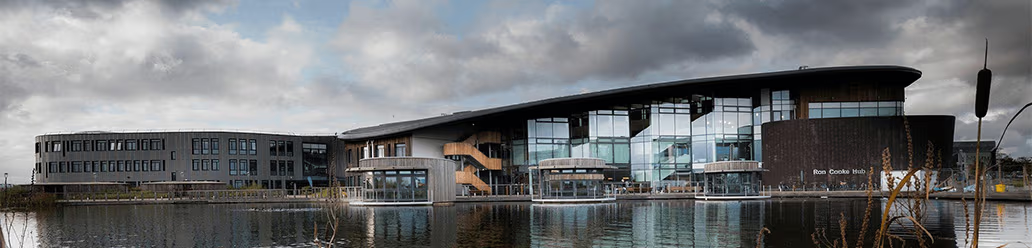

International Humanitarian Affairs
Computing, Engineering and Technology
Taught
MSc
International Humanitarian Affairs
Taught
MSc
Overview
Application Timeline
Tuition
- Year 1
| Student categories | Study | |
|---|---|---|
| Full-time | Part-time | |
| Republic of Ireland | N/A | N/A |
| EU | N/A | N/A |
| International | N/A | N/A |
| England | N/A | N/A |
| Northern Ireland | N/A | N/A |
| Scotland | N/A | N/A |
| Wales | N/A | N/A |
| Channel Islands | N/A | N/A |
Requirements
Language requirements information is currently unavailable.
Modules
Modules is currently unavailable
Please check back later for updates.
About
Team Expertise
Our team possesses extensive experience from various regions including Sub-Saharan and West Africa, the Middle East, Asia, and Latin America. They have responded to numerous disasters such as tsunamis, earthquakes, floods, and civil conflicts.
Research and Collaboration
The team conducts research and practice-oriented projects in disaster and conflict-affected countries, collaborating with:
- United Nations (UN)
- International Non-Governmental Organizations (INGOs)
- National governments
- Local communities
This collaboration aims to challenge and improve policy and practice to ensure effectiveness, efficiency, and relevance.
...
Subject Area Information
Emergency and disaster technologies is a multidisciplinary field that focuses on the development, implementation, and management of technologies designed to prepare for, respond to, and recover from emergencies and disasters. This discipline integrates principles from engineering, information technology, public health, and emergency management to create robust systems that enhance resilience and mitigate the impacts of natural and man-made disasters.
1. Introduction to Emergency and Disaster Technologies
2. Geospatial Technologies for Disaster Management
3. Communication Systems in Emergencies
4. Disaster Robotics and Drones
5. Cybersecurity in Emergency Management
6. Data Analytics for Disaster Response
- Proficiency in using GIS and remote sensing tools for disaster management.
- Ability to design and implement resilient communication systems.
- Hands-on experience with disaster robotics and UAVs.
- Knowledge of cybersecurity principles and practices in the context of emergency management.
- Data analytics skills for interpreting and utilizing disaster-related data.
Career
A discipline in emergency and disaster technologies equips students with the technical skills and knowledge necessary to enhance disaster resilience and response. The integration of advanced technologies in this field opens up numerous career opportunities aimed at safeguarding communities and infrastructure from the adverse effects of disasters.
Emergency Management Specialist
Professionals who plan and coordinate emergency response efforts.
Disaster Recovery Coordinator
Experts who manage the recovery process after a disaster.
GIS Analyst
Specialists who use geospatial data to support disaster management.
Cybersecurity Analyst
Professionals who protect emergency management systems from cyber threats.
Robotics Engineer
Engineers who design and deploy robots for disaster response.
Data Scientist
Experts who analyze disaster-related data to improve response and recovery efforts.
Similar courses
Contact


Enhance your academic journey with the help from our experts.
Contact
Enhance your academic journey with the help from our experts.